
By the end of this you'll know how to use AI to turn a construction contract into an insurance checklist, match it to the policy, and keep sub certificates from slipping.
Construction runs on paper. Specifically, on the insurance section of a contract nobody reads until a claim.
Article 11. Exhibit D. Contractor shall maintain... followed by a page and a half of limits, endorsements and wording. Then the GC wants a certificate by tomorrow. Then the GC wants certificates from every sub. Then one of those certificates quietly expires in March.
AI is excellent at this, because under the jargon the job is matching. The contract says one thing, the policy says another, and somebody has to line them up.
What can AI do for contractor accounts?
Read, match and track. The three jobs that eat a construction book.
| Job | What AI does | What you check |
|---|---|---|
| Contract review | Pull every insurance requirement into a checklist | That nothing was missed or reworded |
| Endorsement match | Compare the checklist to the policy's endorsements | Edition dates and blanket wording |
| Certificates | Draft the ACORD 25 with the right boxes and description | That every mark has an endorsement behind it |
| Sub COI tracking | Read incoming sub certificates and flag gaps and expirations | The follow-up with the sub |
| Renewal | Re-run every active contract's requirements against the renewal policy | That nothing dropped off |
How do you turn a contract into a checklist?
Give AI the insurance section and ask for a table. Never a summary.
Summaries smooth things over. A table keeps every requirement on its own row, where you can see it.
You are reviewing the insurance requirements in a construction contract.
From the attached section, list every requirement as a row:
coverage line, limit (per occurrence, aggregate, per-project aggregate),
additional insured (ongoing ops, completed ops, how long), waiver of
subrogation (which lines), primary and noncontributory, notice of
cancellation, umbrella or excess, and anything else that's required.
Quote the contract's exact words in a column next to each row,
with the section number. Do not paraphrase the quote. Do not add
requirements that aren't written.
Contract: [PROJECT NAME], [GC NAME]
Quote the contract's exact words. That column is your protection. When the GC's risk manager pushes back, you're arguing about their language, not a summary of it.
How do you match requirements to endorsements?
Line by line, against the actual forms on the policy.
The common ISO forms on a contractor's general liability:
| Contract asks for | Common ISO form | Watch for |
|---|---|---|
| Additional insured, ongoing operations | CG 20 10 | Scheduled vs. blanket wording, edition date |
| Additional insured, completed operations | CG 20 37 | Many contracts require it for years after completion |
| Waiver of subrogation | CG 24 04 | Auto and workers comp need their own endorsements |
| Primary and noncontributory | CG 20 01 | Often requires a written contract to apply |
| Per-project aggregate | CG 25 03 | Some carriers use their own form |
Edition dates matter. Insurance Journal's walkthrough of additional insured endorsements in construction explains how they work on a job, and IRMI titled its own series on them, fairly, a potential minefield. Many carriers also use their own blanket forms, so read the wording, not just the number.
Ask AI to put the two tables side by side and mark each row met, not met or can't tell. Every can't tell goes to a person. Every not met is a conversation with the client about an endorsement, before anyone issues a certificate.
This isn't legal advice. Contract terms and coverage questions belong with the client's attorney and the carrier's underwriter.
Why can't the certificate fix a gap?
Because a certificate reports coverage. It doesn't create it.
The ACORD 25 says so in its own box: it's issued as a matter of information only and does not amend, extend or alter the coverage. The Big "I" has explained why wording on a certificate can't give a holder rights the policy doesn't grant, and lawyers warn anyone requiring insurance not to rely on a certificate alone.
So the order never changes:
- Contract requirements, as a checklist.
- Endorsements, matched against it.
- Gaps fixed with the carrier.
- Then the certificate.
Our guide to filling out an ACORD 25 shows which box each endorsement backs.
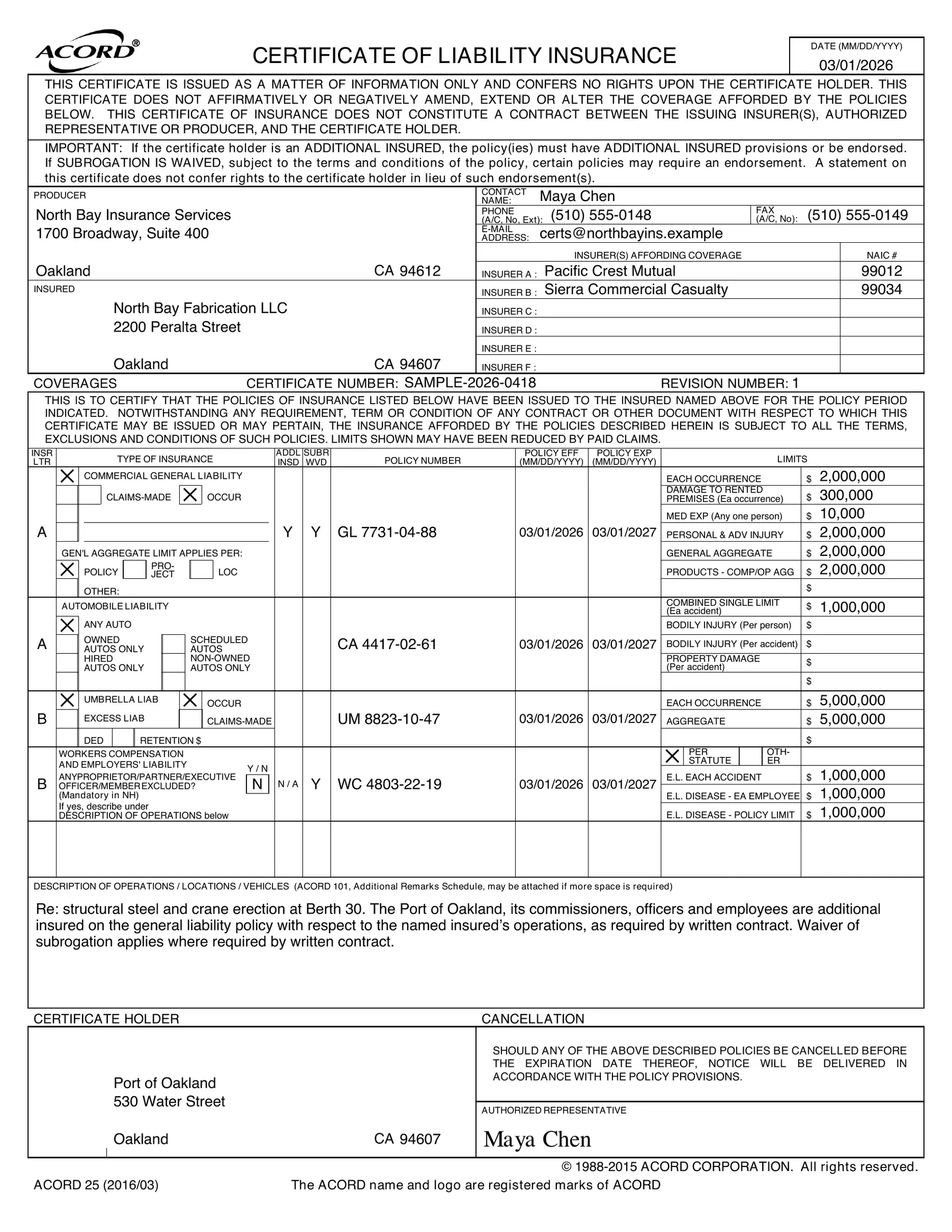
A filled ACORD 25 for a fictional fabrication shop. The additional insured mark is only there because an endorsement backs it.
How do you track subcontractor COIs with AI?
Keep one list of requirements per project, and check every incoming certificate against it.
Your contractor client is on the other side of this too. The GC needs certificates from every sub, and a sub with lapsed coverage can leave the GC holding the loss.
- Build the project's sub requirements from the GC's contract with each sub. Usually they mirror the owner's requirements.
- Read each incoming certificate with AI and pull the insurer, policy numbers, dates, limits, and the additional insured and waiver marks.
- Compare to the requirements and flag anything short.
- Track expiration dates and start asking for renewals 30 days out.
- Ask for endorsements on the jobs where it matters, because the certificate alone doesn't prove them.
Compare the attached subcontractor certificate to these requirements:
[PASTE REQUIREMENTS TABLE].
For each requirement, say met, not met, or not shown on certificate.
List policy expiration dates. Flag any certificate older than 60 days
or any policy expiring in the next 30 days.
Where does AI get construction wrong?
In the places that need a reader who has seen a claim.
- Blanket endorsements. "Where required by written contract" language can satisfy a requirement without naming anyone. AI often marks it not met.
- Edition mismatches. A contract asking for a specific edition can't always be satisfied by a later one.
- Wrap-ups. On OCIP and CCIP projects, the project policy changes what the contractor's own policy has to do. Read the wrap-up manual.
- Professional liability. Design-build work can pull in coverage a GL endorsement can't touch.
Each of these is a can't tell. That's fine. A good AI workflow sends the hard rows to you and handles the rest.
Where should you start?
With your three busiest contractor accounts. Run their open contracts through the checklist prompt and see how many not met rows turn up. That number is usually the argument.
If you'd rather have the certificates handled, Cert Desk does it for agencies. You forward the request, Salience prepares the ACORD 25 and checks it against the policy, and nothing goes out until you approve it. For the full certificate workflow, read certificate of insurance automation. More trade-specific guides are on the AI by line of business shelf.
Give us a call
Hey, all the tech is great, and innovation is great. There's a lot of responsibility and liability across the entire space, and a lot of people are saying the same words that mean different things. Give us a call. We plug in specifically to your processes and take care of the GDS first to unlock you and bring home the bacon.
Call +1 (916) 866-7867 or book a walkthrough.
Would you rather approve this than type it?
Forward the request or the prior application. Salience prepares the form, flags what's missing, and nothing goes out until you approve it.
Frequently asked questions
How can AI help with construction insurance?
It reads the insurance section of a construction contract and turns it into a checklist, compares that checklist to the endorsements on the policy, drafts the certificate, and checks the certificates subcontractors send back.
What are the additional insured requirements in construction contracts?
Most ask for additional insured status on the contractor's general liability for ongoing operations and completed operations, often with waiver of subrogation, primary and noncontributory wording, and per-project aggregates. The exact wording is in the contract and has to be matched to the policy's endorsements.
What is the difference between CG 20 10 and CG 20 37?
CG 20 10 covers the additional insured for the contractor's ongoing operations. CG 20 37 covers completed operations, after the work is finished. Many contracts require both, and the edition dates matter.
Does a contractor certificate of insurance prove additional insured status?
No. A certificate only reports coverage and says it does not amend, extend or alter the policy. Additional insured status comes from the endorsement, so ask for the endorsement when it matters.
How do contractors track subcontractor COIs?
Keep a list of every sub with the coverage the contract requires, check each incoming certificate against it, and watch expiration dates. AI can read the certificates and flag gaps, and a person follows up.