
By the end of this you'll know which commercial desk jobs AI can take today, how to run one through ChatGPT or Claude safely, and which calls stay with you.
You got into commercial lines to place risk. To read a business, find the right market, and stand behind the advice.
So why does your week look like retyping?
The loss runs arrive as scanned PDFs. The supplemental asks for the same payroll the ACORD 125 already has. The certificate request lands at 4:52 on a Friday. Ping. Then another one.
This is where AI earns its seat at a commercial brokerage. It moves information from one document into another, fast, and it never gets bored. What it can't do is decide. That part is still yours, and this guide draws the line job by job.
Where does AI help a commercial broker?
Anywhere information has to move from one document to another. That covers most of the paperwork on a commercial account.
| Job | What AI can do today | What you still decide |
|---|---|---|
| Submission intake | Read the email and attachments, pull the named insured, FEIN, locations, payroll, sales and losses into one list | Whether the account fits your markets at all |
| ACORD 125, 126, 140 | Draft answers from last year's application and the client's new numbers | Every answer that changed, and anything the client didn't tell you |
| Carrier supplementals | Map answers you already have onto a new carrier's questions | The questions only the insured can answer |
| Marketing emails | Write a clean cover note per market, in your voice | Which markets see the account, and in what order |
| Quote comparison | Line up limits, deductibles, exclusions and subjectivities side by side | Which option you recommend, and why |
| Certificates | Prepare the ACORD 25 from the policy | Whether an endorsement backs what the holder asked for |
| Renewals | Flag exposure changes and new losses against last year | The renewal strategy |
Look at the right-hand column. It never gets shorter. AI changes how fast the left column moves.
What should stay with the broker?
Anything that is advice, and anything that is a representation to a carrier.
Coverage recommendations stay with you. So does the call on what goes into an application, because a misstatement there can come back as a denied claim or an E&O file. So does appetite. A model can read a carrier's appetite guide. It doesn't know the underwriter just got burned on a risk like this one.
A simple rule works. If a sentence would change what the client buys or what the carrier believes, a licensed person reads it before it goes out.
This isn't legal advice. Ask your E&O carrier how it views AI-prepared work, and check your state's rules.
How do you run a submission through AI?
Use a business plan, strip what the model doesn't need, and make it show its sources.
- Use a business account. OpenAI says it does not train on ChatGPT Business and Enterprise data by default, and Anthropic's commercial terms bar training on customer content for Claude's business plans. Consumer plans work differently. Our guide on whether ChatGPT is safe for client data walks through the settings.
- Redact before you share. Swap FEINs, driver's license numbers and anything personal for placeholders. The model doesn't need them to sort a payroll schedule.
- Give it everything at once. Prior application, the client's email, the loss runs.
- Ask for a list, not a form. A list is easy to check. A filled form hides its mistakes.
- Make it cite. Every value should point back to the document and page it came from.
- Check each changed answer yourself, then key it into your AMS or the carrier's portal.
Here's a prompt that covers steps 3 to 5:
You are helping a commercial insurance broker prepare a renewal submission.
From the attached documents, list every value an ACORD 125 and 126 need:
named insured, mailing address, locations, entity type, years in business,
description of operations, annual sales, payroll by class, subcontracted
cost, and prior losses.
For each value, name the document and page it came from.
If two documents disagree, show both and say which is newer.
If a value is missing, write MISSING. Do not guess.
Client: [CLIENT NAME]   Term: [EFFECTIVE DATE] to [EXPIRATION DATE]
The most important words in there are the last three. Do not guess. A model allowed to fill blanks will fill them with something plausible, and plausible is how a wrong payroll figure reaches an underwriter.
Field-by-field help for the forms lives in our guides to the ACORD 125 and the ACORD 126.
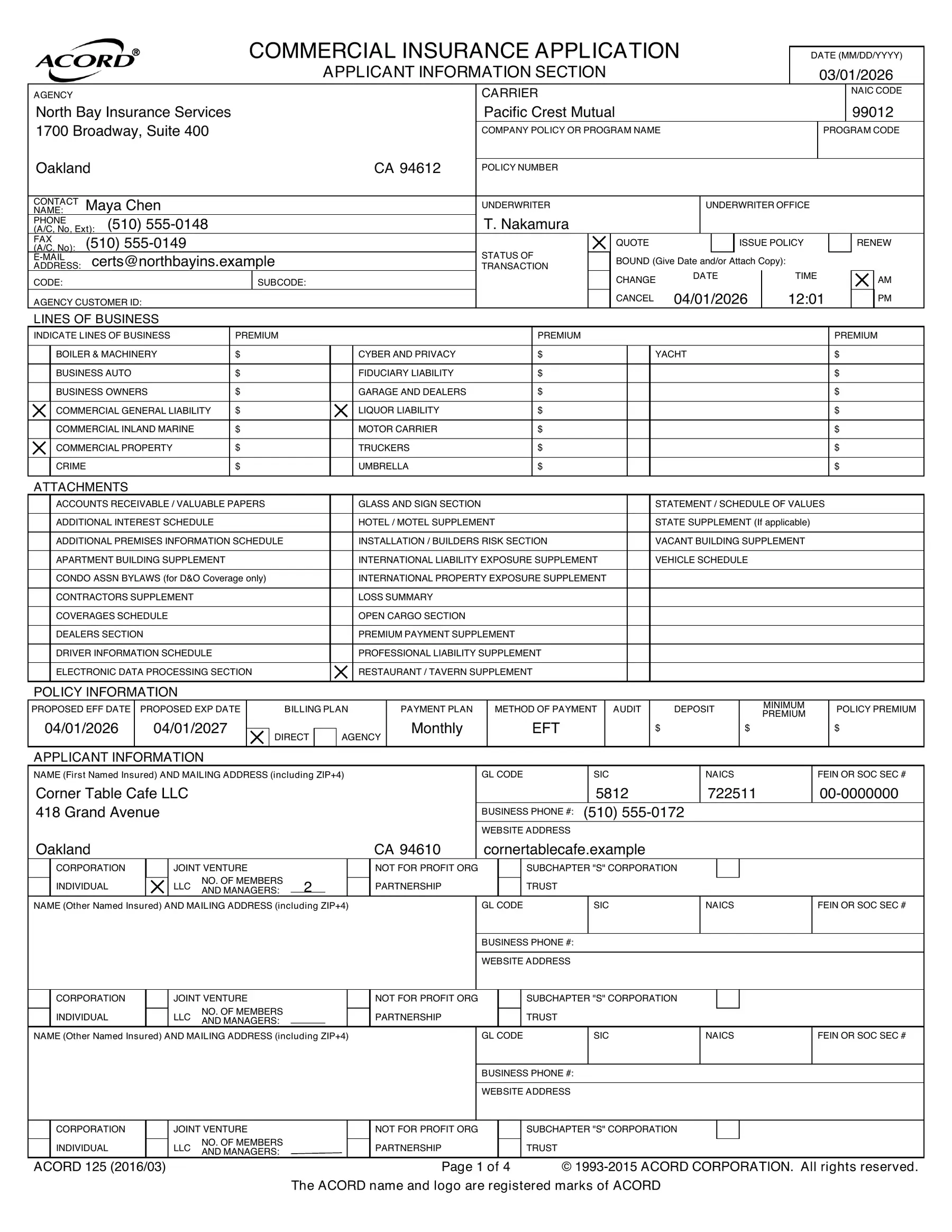
A filled ACORD 125 for a fictional cafe. Every answer traces back to a source document.
Why start with supplementals?
Because they're the same questions in a different order, every single time.
One carrier wants "years in business." Another wants "date established." A third asks both, three pages apart. A contractor supplemental asks about subcontracting four different ways.
That's translation, and translation is what a language model does best. Give it last year's answers and the new supplemental, ask it to map one onto the other and flag anything it can't match. You get a draft in minutes and a short list of questions for the insured.
What you don't do is let it answer questions nobody has asked the insured. Has the applicant ever... gets the insured's answer, or it stays blank.
Where do certificates fit?
Certificates are some of the highest-volume paperwork on a commercial book, and some of the easiest to get quietly wrong.
AI can read the request, find the policy and prepare the ACORD 25. The trap is the request. Holders paste contract language asking for additional insured status, waiver of subrogation, primary and noncontributory wording. A certificate only reports what the policy grants, and a Big "I" column explains that a certificate can't add coverage the policy doesn't carry. So the AI's job is to check the request against the endorsements and flag the gap, not to type the words in.
Our ACORD 25 guide shows which endorsement backs which box.
What are other agencies actually doing?
Individually, a lot. As agencies, much less.
Liberty Mutual's 2026 Independent Agency Growth Study found 65 percent of agents had used AI for work in the past year, and 41 percent used it weekly. In the same study, only 18 percent said their agency had a well-defined AI policy.
The Big "I" Agents Council for Technology found just 8 percent of agencies had AI embedded in daily workflows, even though two-thirds planned to use more of it.
Put those side by side. Your producers are already using chatbots. The open question is whether the agency decides how.
How do you pick AI software for a brokerage?
Ask what happens to the work, not what the demo does.
| Ask the vendor | Why it matters |
|---|---|
| Where does our client data go, and is it used for training? | Your clients' financials and losses are confidential |
| Who reviews the output before a carrier or client sees it? | Someone has to own the representation |
| Can we see where each value came from? | Checking a draft is only fast when it cites its sources |
| What happens when a document is unreadable or missing? | Silence is worse than a flag |
| Does the result land in our AMS, or only in a chat window? | A draft in a chat window still has to be keyed |
| What does "AI agent" mean in your product, exactly? | The phrase means something different at every vendor |
On that last one, our guide to AI agents for insurance agencies lists the questions that cut through it.
Where should you start?
With the desk that buries your best people. For most commercial brokers, that's certificates or renewals.
Pick one. Time it today. Run it with AI for a month, with every output reviewed. Then decide with real numbers.
If you'd rather the desk be handled, that's what Salience does for agencies. You forward the request, Salience prepares the certificate, application or renewal, and nothing goes out until you approve it. More guides by line of business sit on the AI by line of business shelf.
Give us a call
Hey, all the tech is great, and innovation is great. There's a lot of responsibility and liability across the entire space, and a lot of people are saying the same words that mean different things. Give us a call. We plug in specifically to your processes and take care of the GDS first to unlock you and bring home the bacon.
Call +1 (916) 866-7867 or book a walkthrough.
Would you rather approve this than type it?
Forward the request or the prior application. Salience prepares the form, flags what's missing, and nothing goes out until you approve it.
Frequently asked questions
What is the best AI for commercial insurance?
For a broker, the best AI is the one that moves information between documents with sources you can check: a business plan of ChatGPT or Claude for drafting, or a service that prepares the work and waits for your approval. Judge it on accuracy and review, not the demo.
What AI tools do insurance brokers use?
Most brokers start with a general assistant such as ChatGPT, Claude or Microsoft Copilot for reading documents and drafting emails, then add tools built for one job, like submission intake, certificates or policy checking.
Can AI fill out ACORD applications for commercial insurance?
AI can draft ACORD 125, 126 and 140 answers from a prior application and the client's documents. Every answer that changed, and every question only the insured can answer, still needs a person to confirm it before it reaches a carrier.
Is it safe to put commercial client data into AI tools?
Use a business plan that does not train on your data, redact identifiers the model does not need, and check your E&O carrier's view. Consumer chatbot accounts follow different rules.
Will AI replace commercial insurance brokers?
AI takes over the retyping, not the advice. Placing a risk, choosing markets and standing behind a recommendation still needs a licensed broker, and clients still ask for one.