
By the end of this you will be able to complete an ACORD 25 box by box, know which marks need an endorsement behind them, and avoid the mistakes that send a certificate back.
An ACORD 25 is filled from the policies, not from the request. Enter who is involved at the top, list each policy in the coverages grid, mark additional insured and waiver only where an endorsement backs them, then complete the certificate holder. This guide follows the ACORD 25 (2016/03) edition from top to bottom. If you would rather approve certificates than build them, Cert Desk prepares them for you.
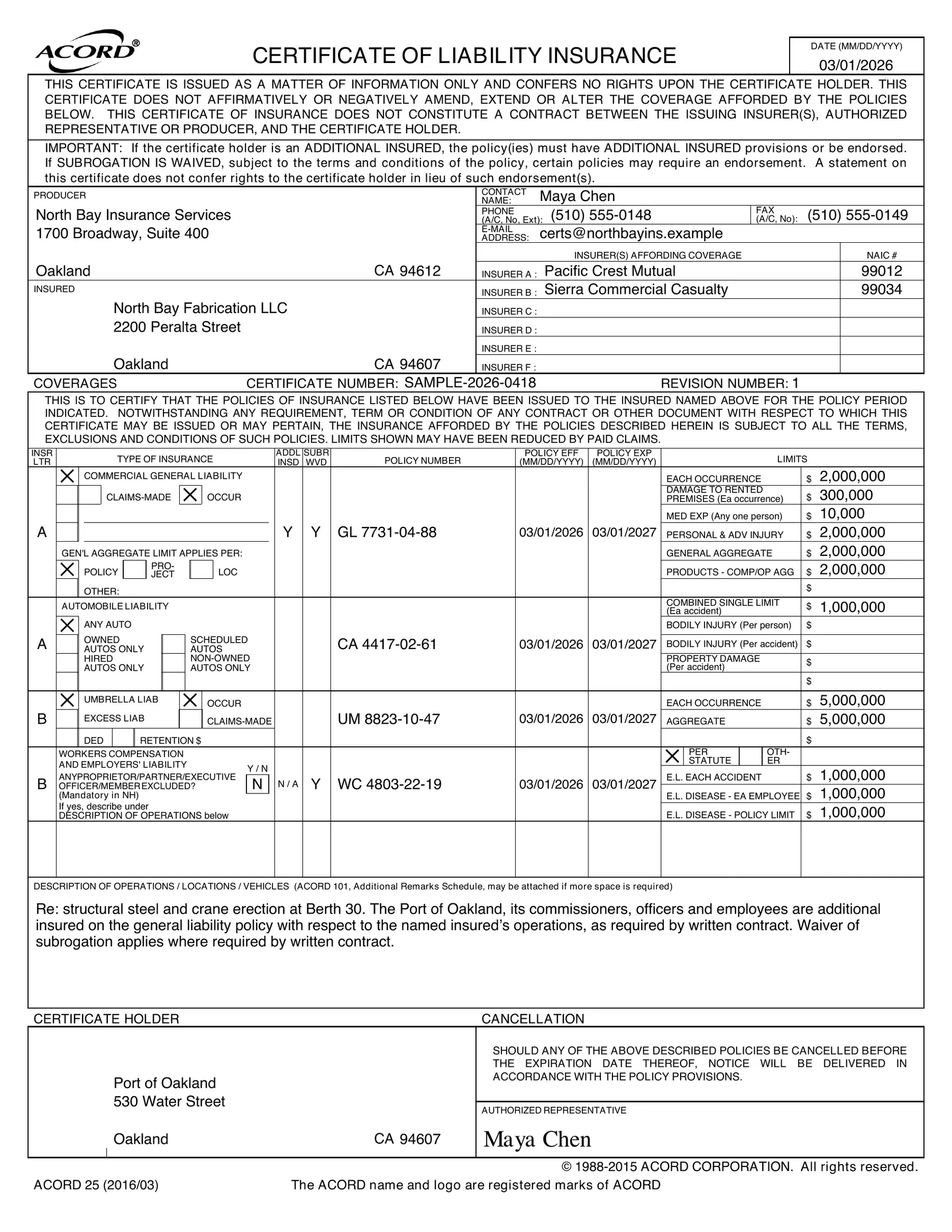
A filled ACORD 25 for a fictional fabrication shop, with the Port of Oakland as holder. Follow along on it. Open it to zoom in.
What is an ACORD 25?
The ACORD 25 is the Certificate of Liability Insurance, the standard form an agency issues to show that a business has coverage in force. It is a snapshot of the policies on the day it is issued.
It reports coverage and nothing more. The form says it is "issued as a matter of information only," confers no rights on the holder, and does not amend, extend or alter the coverage. Every rule below follows from that.
What do you need before you start?
Have the policies open before you touch the form. You need:
- The named insured, exactly as it appears on the policy, and its mailing address.
- Each policy's number, carrier, effective date, expiration date and limits.
- The NAIC number for each carrier.
- The endorsements on each policy, especially additional insured, waiver of subrogation, and primary and non-contributory.
- The holder's legal name and address, and the job or contract reference.
- The contract clause or the holder's written requirements, if you have them.
What goes in the top of the form?
The top identifies who issued the certificate, who it covers, and who insures them.
| Box | What goes there | Watch for |
|---|---|---|
| DATE | The day you issue it | This is the issue date, not a policy date |
| PRODUCER | Your agency's name and address | Use the licensed agency, not an individual |
| CONTACT NAME, PHONE, FAX, E-MAIL | Who answers questions about this certificate | A shared certificates inbox works well |
| INSURED | Named insured and address, as on the policy | A trade name or the wrong entity gets it rejected |
| INSURER A to F | Each carrier on the certificate | One letter per carrier |
| NAIC # | That carrier's NAIC number | Match the writing company, not the group |
| CERTIFICATE NUMBER, REVISION NUMBER | Your own numbering | Use revisions so you can trace reissues |
How do you fill in the coverages grid?
Each policy gets one row, reported exactly as it stands on the policy. Across every row, the columns run INSR LTR, TYPE OF INSURANCE, ADDL INSD, SUBR WVD, POLICY NUMBER, POLICY EFF, POLICY EXP and LIMITS.
Commercial general liability. Tick CLAIMS-MADE or OCCUR. Under GEN'L AGGREGATE LIMIT APPLIES PER, tick POLICY, PROJECT or LOC. Then enter EACH OCCURRENCE, DAMAGE TO RENTED PREMISES, MED EXP, PERSONAL & ADV INJURY, GENERAL AGGREGATE and PRODUCTS - COMP/OP AGG.
Automobile liability. Tick what the policy covers: ANY AUTO, OWNED AUTOS ONLY, SCHEDULED AUTOS, HIRED AUTOS ONLY or NON-OWNED AUTOS ONLY. Most commercial policies show COMBINED SINGLE LIMIT.
Umbrella and excess. Tick UMBRELLA LIAB or EXCESS LIAB, then OCCUR or CLAIMS-MADE, and enter EACH OCCURRENCE and AGGREGATE, with any DED or RETENTION.
Workers compensation. Tick PER STATUTE or OTH-ER, and enter E.L. EACH ACCIDENT, E.L. DISEASE - EA EMPLOYEE and E.L. DISEASE - POLICY LIMIT. The Y/N box asks whether any proprietor, partner, executive officer or member is excluded. If yes, describe it under Description of Operations. The form marks that box mandatory in New Hampshire.
Limits on a certificate must be the policy's limits. If a holder wants higher limits than the policy carries, that is a coverage change, not a certificate.
How do the ADDL INSD and SUBR WVD columns work?
These two columns only report what the policy already grants. The form's own IMPORTANT box says it: an additional insured needs provisions on the policy or an endorsement, and a waiver of subrogation may need one too.
Mark ADDL INSD with a Y on a policy row only when that policy gives the holder additional insured status. Mark SUBR WVD with a Y only when that policy waives subrogation for them.
Check the endorsement before you mark either one. Common ISO forms are CG 20 10 for ongoing operations, CG 20 37 for completed operations, CG 24 04 for waiver of subrogation, and CG 20 01 for primary and non-contributory. Your policy may use a blanket endorsement or a carrier's own form, so read the wording instead of relying on the number.
If the policy does not grant what the holder asks for, do not issue the mark. Tell your client they need an endorsement first.
What goes in Description of Operations?
Use it to tie the certificate to the job and to state what the marks mean. The box is titled DESCRIPTION OF OPERATIONS / LOCATIONS / VEHICLES, and the ACORD 101 Additional Remarks Schedule can be attached if you need more room.
A clear entry names the project, then says who is additional insured, on which policy, and why. In the sample above: the Port of Oakland is additional insured on the general liability policy with respect to the named insured's operations, as required by written contract.
Keep it to what the policy supports. Pasting contract language into this box does not make it true, and the form says a statement on the certificate does not confer rights in place of an endorsement.
What goes in the bottom of the form?
CERTIFICATE HOLDER is the legal name and address of whoever asked for the certificate. Copy it exactly from their request.
CANCELLATION is pre-printed: notice will be delivered in accordance with the policy provisions. Leave that language alone, even when a holder asks for a set number of days' notice. If they need notice terms, those have to come from the policy.
AUTHORIZED REPRESENTATIVE is the signature of the person authorized to sign for the agency.
What gets a certificate rejected?
Most rejections come from a mismatch between the request and the certificate.
- Wrong named insured. A trade name, a parent company, or the wrong entity in a group.
- Holder name that does not match the contract, down to the suffix.
- Expired or nearly expired policy dates. Check the term covers the job.
- Additional insured missing on the policy the holder cares about, usually general liability.
- Limits below what the contract requires. Fix this with coverage, not with the form.
- Missing project reference in Description of Operations.
- A waiver or primary wording requested and never addressed.
Which form do they want? If a lender or landlord asks about a building, they usually want an ACORD 28, Evidence of Commercial Property Insurance, not an ACORD 25.
Would you rather approve it than build it?
Then hand it over. You forward the request to Cert Desk, Salience prepares the ACORD 25 and checks it against the policy, and you approve it before it goes out. It costs less than your current overhead on certificates.
The same set of pages covers the rest of the decision: certificates for small agencies, high-volume commercial agencies, AMS360 agencies, the best certificate of insurance software, outsourcing certificates, and certificate of insurance automation.
Would you rather approve this than type it?
Forward the request or the prior application. Salience prepares the form, flags what's missing, and nothing goes out until you approve it.
Frequently asked questions
How do I fill out an ACORD 25?
Work from the policies, not the request. Enter the date, producer, insured and insurers, then one row per policy in the coverages grid with its number, dates and limits. Mark ADDL INSD and SUBR WVD only where an endorsement backs them, add any description of operations, then complete the certificate holder and sign.
How do I add an additional insured on a certificate of insurance?
Mark Y in the ADDL INSD column on the policy row and say who and for what in Description of Operations. The certificate only reports it, so the policy must carry an additional insured provision or endorsement first.
What is the difference between a certificate holder and an additional insured?
A certificate holder receives proof of insurance and gets no rights under the policy. An additional insured has rights under the policy, granted by a provision or endorsement. A party can be both, but one does not create the other.
What is the difference between an ACORD 25 and an ACORD 28?
The ACORD 25 is a certificate of liability insurance. The ACORD 28 is evidence of commercial property insurance, the form a lender or landlord usually wants for a building.
Can you change the wording on an ACORD 25?
Do not alter the form's printed language. A certificate does not amend, extend or alter coverage, and it says so at the top. Wording a holder wants added has to match what the policy actually grants.
What goes in the INSR LTR column?
The letter of the insurer writing that policy, A through F, matching the insurer list at the top of the form.