
By the end of this you'll know which Claude plan an agency should be on, and how to put Projects, long-document reading, Skills and Cowork to work on real agency jobs.
Ever handed a 140-page policy to someone and asked, "Does this cover the subcontractor's equipment?"
That's the kind of question Claude was built to sit with. It reads long documents patiently, it writes in a steady voice, and it follows instructions closely. Those three things cover a surprising amount of what an agency does all day.
Here's how to set it up so it helps instead of creating a new mess.
Pick the plan before the prompt
Put agency work on Claude Team or Claude Enterprise. Not on someone's personal account.
The reason is the data terms. Anthropic's Commercial Terms, which cover Team, Enterprise and the API, say Anthropic may not train models on Customer Content from Services. Personal accounts are different. Since Anthropic's August 2025 update to its consumer terms, chats on Free, Pro and Max can be used to train models unless the user opts out.
If you write health or benefits business, the bar is higher again. Anthropic offers a Business Associate Agreement for its HIPAA-ready services, such as Claude Enterprise with HIPAA settings turned on, and it has to be in place before protected health information goes anywhere near the tool. Our guide to whether AI tools are safe for client data walks through it.
Plans and prices change. Check Anthropic's own pricing page before you buy, and ask your E&O carrier and your carriers' agency agreements what they expect.
Use Projects for the work you repeat
A Project is a workspace with its own instructions and its own documents. Anthropic's help center explains what Projects are and how they work.
Think of each Project as a desk drawer for one recurring job:
- Renewal letters. Your template, your tone, your sign-off.
- Carrier appetite notes. The guidelines and bulletins you keep re-reading.
- Service replies. Your agency's answers to the twenty questions clients ask every month.
Then write project instructions once. Something like this:
You help the service team at [AGENCY NAME], an independent agency in [STATE].
Use the templates in this project. Match their tone and length.
Never state that a loss is covered. Point to the form or endorsement that decides it.
Put [BRACKETS] around any fact you were not given. Never guess a policy number, limit or date.
When you quote a document, name the file and page.
Keep client files out of Projects unless your plan, your AI policy and your carrier agreements say they can be there.
Read long policies and loss runs
This is where Claude earns its seat. It can take a long PDF and answer questions about it. The trick is to make it show its work.
Ask for citations every time:
This is a commercial package policy with names removed.
1. List every coverage part and its limits in a table: coverage, limit, deductible, form number, page.
2. List every endorsement by form number and title.
3. Flag anything that looks like an exclusion a [INDUSTRY] business would trip over, with the page it is on.
If you cannot find something, write "not found" instead of guessing.
Then open the policy and check the rows that matter. Summaries miss things. An endorsement on page 97 changes the answer on page 12.
Loss runs work the same way:
These are five years of loss runs for one account, claimant names removed.
Build one table: policy year, carrier, line, date of loss, cause, paid, reserved, total incurred, open or closed.
Under the table, list the three patterns an underwriter would ask about first.
Do not add up totals in your head. Show each total as a sum of the rows.
That last line matters. Ask for the arithmetic laid out so you can check it. More on this in using AI to read loss runs and using AI to read an insurance policy.
Write a skill for your house style
A skill is a folder of instructions, and sometimes files, that Claude loads when a task calls for it. Anthropic introduced them as Agent Skills, and the Skills overview covers how to add your own.
Why would an agency care? Consistency. Five people writing renewal letters produce five different letters. One skill produces one.
Good first skills for an agency:
- Renewal letter. Your structure, your required disclosures, your reply-by language.
- Certificate request intake. The questions to answer before anyone touches an ACORD 25: holder, project, wording, waiver, primary and noncontributory.
- Submission checklist. What each carrier wants before you send a new commercial account.
Write the skill the way you'd train a sharp new hire. Plain steps. Real examples. The mistakes that bounced the last submission.
Where Cowork fits
Cowork is the part of Claude that carries out multi-step tasks with files you give it, instead of only chatting. Anthropic previewed it in January 2026, and The Register covered the launch. Anthropic's guide to getting started with Cowork shows the current setup, which changes often, so follow that page rather than a screenshot from last quarter.
For an agency, that looks like:
- Sorting a renewal folder. Twelve PDFs named "scan0043.pdf" become dec pages, loss runs, schedules and correspondence, each renamed.
- Building a renewal checklist. It reads what's in the folder and lists what's missing.
- Drafting the client package. A summary of changes, ready for you to edit.
Read Anthropic's page on using Cowork safely first. Give it only the folders it needs. Review before anything is sent. A tool that can move files can also move the wrong one.
What Claude won't do for you
Claude reads and writes. It doesn't own the outcome.
It won't know your carrier's underwriter just changed appetite for roofers. It won't notice the holder wants wording the policy doesn't support unless you ask. And when it's wrong, it's wrong in fluent, tidy paragraphs, which makes the mistake harder to see.
So the rule stays the same as with any tool: a licensed person reads it, a licensed person sends it.
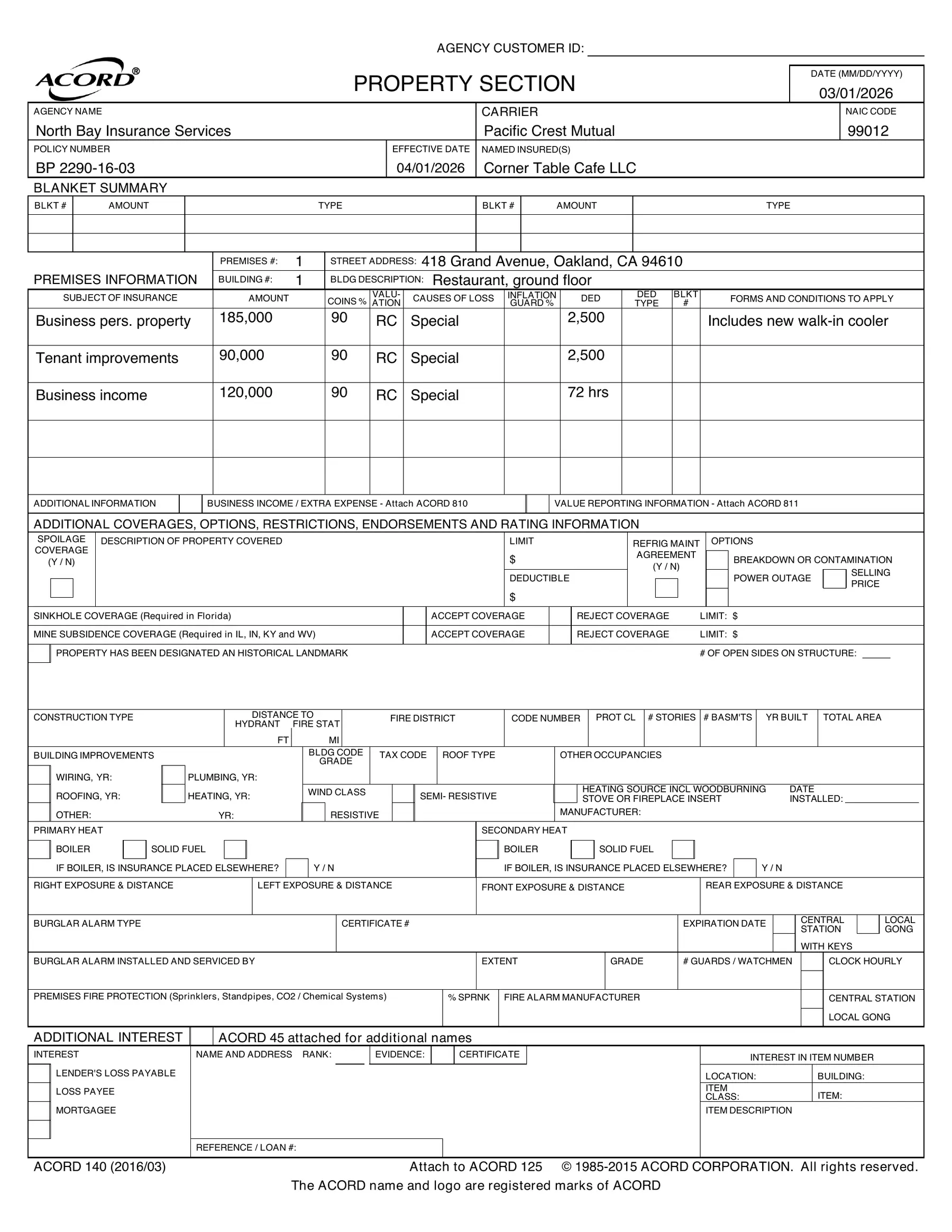
A finished ACORD 140 for a fictional cafe at renewal. This is the kind of output that still needs a person to check it against the policy.
And if the honest answer is that nobody at the agency has time to run prompts all day, that's the work Salience takes off the desk. You forward the request. Salience prepares the certificate, the application or the renewal and checks it against the policy. Nothing goes out until you approve it.
Weighing Claude against ChatGPT? Read ChatGPT vs Claude for insurance work, or see every guide on the AI tools shelf.
Give us a call
Hey, all the tech is great, and innovation is great. There's a lot of responsibility and liability across the entire space, and a lot of people are saying the same words that mean different things. Give us a call. We plug in specifically to your processes and take care of the GDS first to unlock you and bring home the bacon.
Call +1 (916) 866-7867 or book a walkthrough.
Would you rather approve this than type it?
Forward the request or the prior application. Salience prepares the form, flags what's missing, and nothing goes out until you approve it.
Frequently asked questions
Is Claude good for insurance agencies?
It is strong at reading long documents and writing in a consistent voice, which covers a lot of agency work: policy summaries, loss run tables, renewal letters and service emails. A licensed person still checks anything that touches coverage.
Does Claude train on my agency's data?
On Team and Enterprise, which run under Anthropic's Commercial Terms, Anthropic says it does not train on customer content. On personal Free, Pro and Max accounts, chats can be used for training unless the user opts out.
What is Claude Cowork for insurance agents?
Cowork lets Claude work through multi-step tasks with files you give it access to, such as sorting a folder of renewal documents or building a checklist from them. Give it only the folders it needs and review what it produces before anything leaves the agency.
What are Claude skills for insurance?
A skill is a packaged set of instructions, and sometimes files, that Claude loads when a task calls for it. An agency can write one for its renewal letter format or its certificate request checklist so every person gets the same result.
Can Claude read a whole insurance policy?
Yes, it can read long PDFs and answer questions about them. Ask it to cite the form number and page for every answer, then open the policy and check, because summaries can miss an endorsement.